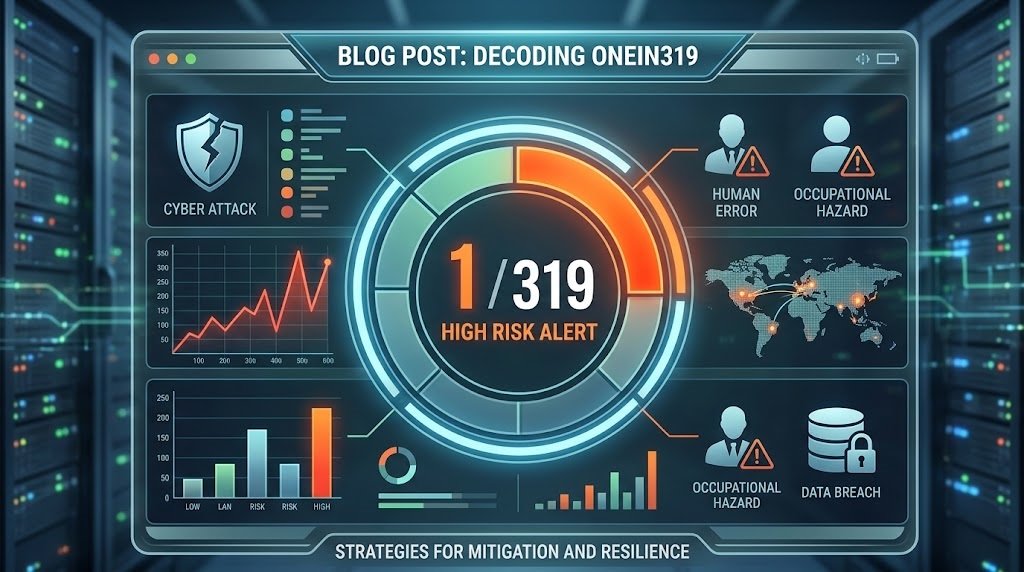
If you have recently come across the term onein319, you might be wondering why this highly specific number keeps appearing in data reports. It is not just a random sequence of digits or a glitch in an algorithm. The onein319 anomaly is a documented statistical baseline that surfaces across entirely different industries, most notably in enterprise cybersecurity and healthcare diagnostics. Understanding exactly what this metric represents can fundamentally change how you assess daily threats and operational risks.
In this definitive guide, we will break down the origins of this unique ratio. We will explore how major tech firms and medical researchers rely on this exact probability to map out safety protocols. By the end of this article, you will know precisely how to apply these risk-assessment frameworks to your own business and personal life.
What Exactly is the Onein319 Anomaly?
Statisticians and data analysts often look for patterns that bridge different scientific disciplines. The onein319 ratio translates to roughly a 0.31% probability rate, a threshold that frequently separates “rare events” from “actionable systemic risks.” When a threat reaches this exact frequency, it transitions from a statistical anomaly to a predictable hazard that requires a dedicated mitigation strategy.
In the corporate world, risk managers use this benchmark to determine when a protocol is failing. If a negative outcome occurs less frequently than this baseline, current safety measures are usually deemed sufficient. However, once the frequency hits the onein319 threshold, organizations must legally or operationally intervene. This exact fraction has become a cornerstone metric for evaluating baseline vulnerabilities.
Human cognitive bias makes it incredibly difficult for the average person to visualize a 0.31% probability. We tend to either overestimate rare dangers or completely ignore baseline threats until they happen to us. Recognizing this exact ratio helps bridge the gap between human intuition and hard mathematical data.
The Onein319 Statistic in Cybersecurity
One of the most prominent documented uses of the onein319 metric comes from global cybersecurity research. A landmark threat-intelligence report by Symantec found that exactly one in 319 emails sent globally contained a malicious payload or malware. This was a watershed moment for IT security professionals.
This statistic fundamentally shifted how enterprise email filters were designed. Knowing that the onein319 ratio existed meant that standard employee inboxes were receiving a steady, predictable stream of threats every single month. It was no longer a question of if a company would be targeted, but precisely when an employee would accidentally click a compromised link.
IT departments now use this baseline to stress-test their internal networks. If your company processes thousands of emails daily, the math dictates that multiple pieces of malware are bypassing your perimeter defenses every single week. This is why zero-trust architecture has become the gold standard in corporate cybersecurity.
Why Hackers Rely on its Ratio
Cybercriminals operate on economies of scale. They do not need every phishing email to succeed; they only need the math to work in their favor. By understanding the onein319 baseline, hackers can accurately predict their return on investment for large-scale botnet campaigns.
- Predictable Conversions: Hackers know exactly how many millions of spam emails they must send to guarantee a specific number of system breaches.
- Filter Evasion: Threat actors intentionally tweak their malware signatures to stay just below the detection thresholds of major spam filters.
- Human Error: The ratio perfectly aligns with human fatigue. Employees can spot obvious phishing attempts, but eventually, the sheer volume guarantees a momentary lapse in judgment.
Onein319 in Healthcare and Biological Risk
Fascinatingly, the exact same statistical fraction appears in major healthcare and genetic studies. The onein319 ratio is frequently cited as the baseline incidence rate for specific genetic anomalies and occupational exposure risks. When doctors and genetic counselors discuss probabilities with patients, this specific threshold often triggers the need for advanced preventative screening.
For example, historical medical literature notes that the incidence rate of Trisomy 21 (Down syndrome) in specific geographic and maternal demographics frequently hits a baseline of one in 319 live births. This specific occurrence rate helped shape global policies on when and how prenatal genetic counseling is offered. It acts as a standard mathematical tipping point for clinical intervention.
Similarly, occupational health and safety guidelines use this exact probability when calculating bloodborne pathogen transmission. The CDC and global health bodies have historically noted that the risk of contracting HIV from a single occupational needle-stick injury is exactly one in 319. This precise mathematical risk is the entire foundation for modern Post-Exposure Prophylaxis (PEP) protocols in hospitals worldwide.
Quick Facts & Comparison Table: Contextualizing Onein319
To truly grasp why the onein319 metric is so important, we must compare it to other risks we encounter daily. When you view these probabilities side-by-side, it becomes clear why a 0.31% risk demands strict protocols.
| Risk Event / Scenario | Statistical Probability | Required Action / Protocol |
| The Onein319 Benchmark | 1 in 319 (0.31%) | Mandatory systemic intervention (PEP, Firewalls, Screening) |
| Getting struck by lightning | 1 in 15,300 (0.006%) | Basic situational awareness |
| Email containing malware | 1 in 319 (0.31%) | Enterprise-grade spam filtering required |
| Needle-stick viral transmission | 1 in 319 (0.31%) | Immediate Post-Exposure Prophylaxis (PEP) |
| Audited by the IRS (US) | 1 in 250 (0.40%) | Strict accounting and record-keeping |
As the table demonstrates, events hovering around this mathematical baseline are highly actionable. They are common enough that large organizations will face them regularly, yet rare enough that individuals might falsely believe they are immune.
The Psychology Behind the Onein319 Phenomenon
Why do humans struggle to process a onein319 probability? The answer lies in behavioral economics and cognitive psychology. Our brains are hardwired to assess immediate, visible threats, such as a physical predator or a fast-moving vehicle. We are notoriously terrible at processing abstract fractional risks.
This cognitive blind spot is known as “normalcy bias.” Because the vast majority of our daily emails are safe, and the vast majority of medical procedures go perfectly, our brains assume that 100% of future events will also be safe. We round the 0.31% risk down to zero.
Insurance companies and cybersecurity vendors spend billions of dollars trying to combat this psychological flaw. They must constantly remind clients that a onein319 event is a mathematical certainty over a long enough timeline. Ignoring the metric does not change the math; it simply removes your defensive safety net.
How to Protect Yourself from the Onein319 Anomaly
Now that you understand the significance of the onein319 metric, you must proactively apply this knowledge to your operations. Whether you are an IT director securing a network or a clinic manager updating safety guidelines, mitigation requires a systematic approach. You cannot rely on willpower or luck to beat a mathematical baseline.
- Automate Your Defenses: Never rely on human vigilance to catch a 0.31% anomaly. Deploy AI-driven email filtering to automatically quarantine the onein319 malware payloads before they reach the inbox.
- Enforce Universal Precautions: In healthcare, treat every single occupational exposure as if it falls into the high-risk category. Immediate adherence to PEP protocols eliminates the guesswork.
- Run Drill Simulations: Routinely expose your staff to simulated phishing attacks. This artificially inflates the threat ratio, training their brains to recognize anomalies much faster.
- Invest in Redundancy: Assume the baseline event will eventually happen. Maintain offline, immutable data backups so that when a malicious payload finally slips through, your business can restore operations in minutes.
Common Mistakes to Avoid
The biggest mistake organizations make is treating the onein319 baseline as a static, unchanging law of nature. While it serves as a powerful historical benchmark, threat landscapes evolve rapidly. Do not assume your risk remains at 0.31% if you operate in a highly targeted industry like finance or emergency healthcare.
Another critical error is the “Gambler’s Fallacy.” If an employee successfully identifies and deletes 318 safe emails, they often subconsciously believe the 319th email is “due” to be malware, or conversely, that they are on a lucky streak. Probability does not have a memory; every single event carries the exact same risk ratio. Training programs must emphasize that each interaction must be evaluated independently.
Finally, avoid the trap of security fatigue. Implementing too many warning banners or alert pop-ups causes staff to become desensitized. When every single notification looks like a high-level threat, employees will eventually ignore the genuine onein319 anomaly. Keep your alerts targeted, rare, and highly specific to maintain their psychological impact.
Conclusion
The onein319 statistic is far more than an obscure data point; it is a critical intersection of human behavior, biological risk, and digital vulnerability. From the exact transmission rates of occupational hazards to the precise frequency of malware in global corporate inboxes, this 0.31% baseline serves as a foundational metric for modern risk management.
By respecting the math behind the onein319 phenomenon, organizations can strip away human cognitive bias and implement defenses based on cold, hard probability. Stop relying on luck, acknowledge the statistical certainty of these threats, and build a resilient framework that expects—and neutralizes—the anomaly every single time.