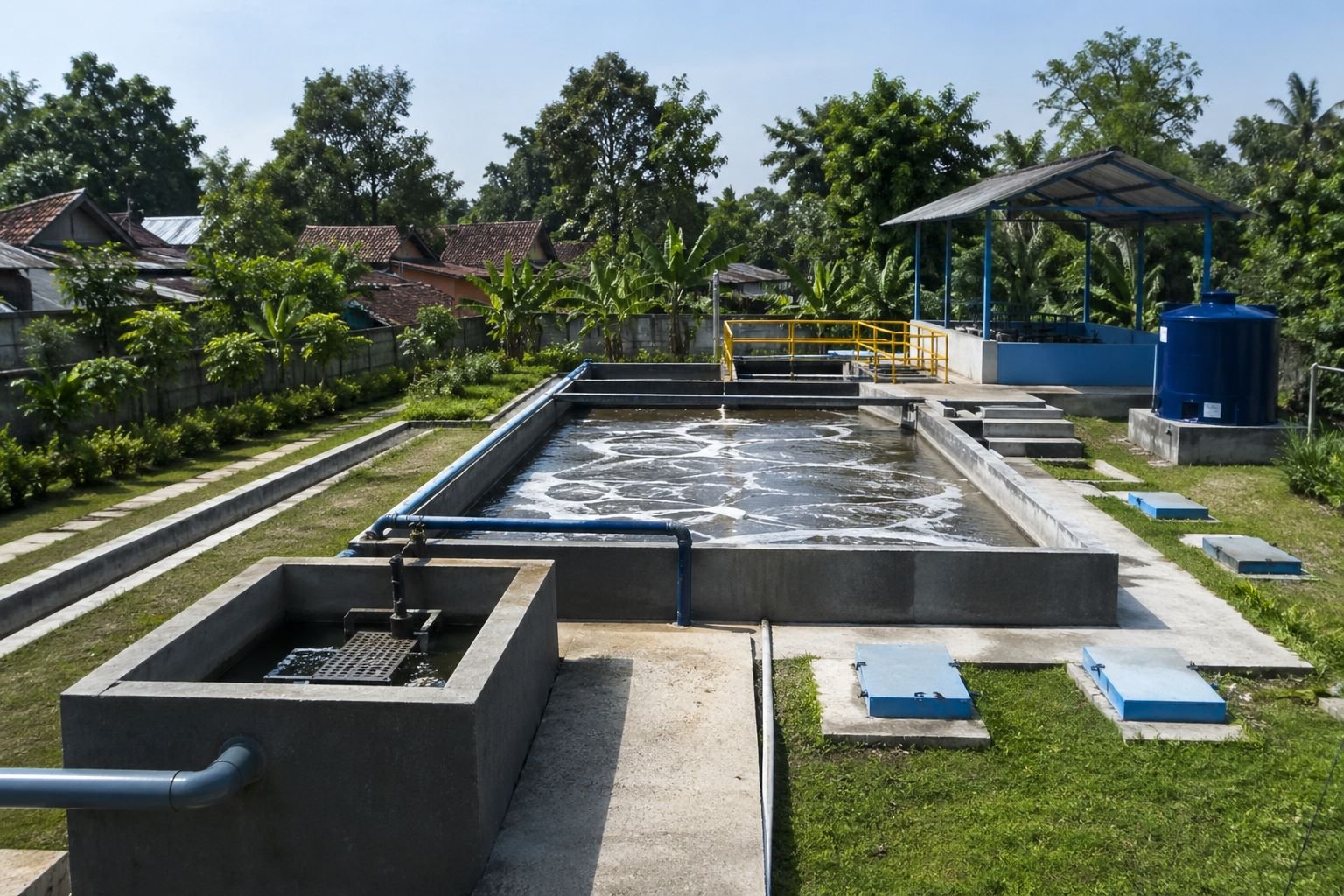
IPAL Komunal ABR Technology combines a communal wastewater treatment plant, known as an IPAL komunal, with an Anaerobic Baffled Reactor (ABR). The approach is designed for domestic wastewater treatment in neighborhoods and other shared facilities, using anaerobic biological processes across a series of baffled chambers.
Rather than relying on mechanical aeration as the primary biological treatment method, an ABR creates repeated upflow and downflow through compartments containing active anaerobic biomass. This configuration improves contact between wastewater and microorganisms while helping retain solids inside the reactor.
The real value of an IPAL Komunal ABR Technology system, however, goes beyond the reactor itself. Hydraulic capacity, wastewater characteristics, retention time, pipe networks, sludge management, operator capability, and final effluent requirements all influence whether a communal treatment system performs reliably.
What Is IPAL Komunal ABR Technology?
IPAL komunal refers to a shared wastewater treatment facility serving multiple households, buildings, or users within a defined area. Instead of every property treating wastewater independently, flows are collected and directed to a centralized or decentralized communal treatment system.
An Anaerobic Baffled Reactor is a tank divided into a series of chambers by vertical baffles. These baffles force wastewater to move upward through the accumulated sludge before flowing into the next compartment, increasing contact between pollutants and anaerobic microorganisms.
This makes IPAL Komunal ABR Technology particularly interesting for projects where low energy use, relatively simple mechanical operation, and efficient land use are important considerations.
It is essential to understand, though, that ABR is often one component within a broader treatment train. Depending on the required effluent quality, designers may need additional treatment stages before discharge or reuse.
How Does IPAL Komunal ABR Technology Work?
The basic treatment sequence is straightforward, but each stage has an important role.
1. Wastewater collection
Wastewater from connected homes or buildings enters the communal sewer network and travels toward the treatment facility. Pipe diameter, slope, flow velocity, access points, and elevation differences should be assessed carefully during design.
Poor collection-system design can create blockages and infiltration problems before wastewater even reaches the reactor.
2. Preliminary or primary settling
Larger solids and heavy materials need to be removed or settled before biological treatment. An initial settling compartment can reduce the solids load entering the main anaerobic reactor.
This stage also helps protect downstream treatment units from excessive accumulation and hydraulic disturbances.
3. Anaerobic treatment in the ABR
Once inside the reactor, wastewater passes through several baffled chambers. The up-and-down movement exposes the incoming wastewater to sludge containing microorganisms that break down biodegradable organic matter.
The compartmentalized structure helps retain biomass while allowing wastewater to move progressively through the reactor.
4. Secondary or polishing treatment
An ABR may not, by itself, produce effluent suitable for every discharge or reuse requirement. Depending on the project, additional technologies such as anaerobic filters, aerobic treatment, ponds, constructed wetlands, or disinfection may be incorporated.
The correct configuration depends on influent quality and the final effluent standard rather than on ABR performance alone.
5. Final discharge or reuse
Treated wastewater must be managed according to its intended destination. Discharge to a receiving water body, infiltration, or controlled reuse can involve different quality requirements.
The treatment objective should therefore be established before the process configuration is finalized.
Main Components of IPAL Komunal ABR Technology
A typical system can include several interconnected components:
| Component | Main Function |
|---|---|
| Wastewater collection network | Collects wastewater from connected users |
| Inlet or equalization structure | Controls incoming flow and protects the process |
| Settling chamber | Removes larger and settleable solids |
| ABR chambers | Provides anaerobic biological treatment |
| Secondary treatment | Provides additional pollutant removal when required |
| Final settling or polishing unit | Improves effluent quality |
| Sampling chamber | Allows monitoring of treated wastewater |
| Sludge management system | Supports periodic sludge removal and handling |
| The exact configuration should be customized to the site. A treatment plant serving a small residential cluster will not necessarily require the same process units as one serving a larger mixed-use development. |
Why Choose IPAL Komunal ABR Technology?
Lower energy requirements
One of the strongest advantages of the ABR concept is that the main reactor does not require mechanical aeration. This can reduce electricity consumption compared with treatment processes that depend heavily on continuous aeration.
This does not mean an entire treatment plant requires no electricity. Pumps, lighting, monitoring equipment, and downstream treatment units can still consume energy.
Simple mechanical configuration
An ABR has relatively few moving mechanical components inside the biological reactor. That can simplify operation and reduce dependence on specialized mechanical equipment.
For communities with limited technical resources, this characteristic can be especially valuable.
Good solids retention
The baffle arrangement encourages microorganisms and solids to remain within the reactor rather than being washed out immediately. The separation between hydraulic retention and solids retention is one of the features that makes ABR technology useful for decentralized sanitation.
Suitable for communal treatment
A single facility can treat wastewater generated by many users. When properly designed, this can provide a practical alternative to installing and maintaining separate treatment units for every building.
Robustness under variable loading
ABRs are generally recognized for their ability to tolerate certain hydraulic and organic fluctuations. Nevertheless, robustness should not be confused with unlimited capacity. Overloading, toxic substances, and poor maintenance can still damage treatment performance.
Limitations of IPAL Komunal ABR Technology
No wastewater technology is universally suitable.
An ABR produces anaerobic effluent and sludge that may still require additional treatment or careful management. SSWM guidance notes that both sludge and effluent can require further treatment after the ABR stage.
Another limitation is that anaerobic treatment alone is not always enough to meet a project’s final nutrient, pathogen, or organic pollutant targets. A polishing stage may therefore be necessary.
Odor management also deserves attention. Anaerobic systems can produce gases, so reactors require appropriate ventilation and controlled gas release.
Finally, buried infrastructure can create a false impression that maintenance is unnecessary. Access covers, inspection points, vents, inlet structures, and sludge-removal arrangements should remain accessible throughout the facility’s operating life.
Key Design Factors for IPAL Komunal ABR Technology
A successful IPAL Komunal ABR Technology project begins with site-specific engineering rather than copying dimensions from another installation.
Wastewater flow
Designers need to determine average daily flow, peak flow, seasonal variation, current occupancy, and projected future demand.
Population alone is not enough. Water consumption habits and the percentage of consumed water entering the sewer system can substantially affect actual wastewater flow.
Hydraulic retention time
Hydraulic retention time, or HRT, describes how long wastewater remains inside the reactor. It is one of the key design parameters because sufficient contact time is needed for biological treatment.
Reference guidance commonly identifies HRT, upflow velocity, and the number of upflow chambers among the critical ABR design parameters.
Number of compartments
The number and arrangement of chambers determine how wastewater interacts with the retained biomass. Reference designs commonly use multiple upflow compartments rather than a single undivided chamber.
More chambers do not automatically mean better treatment. The arrangement must balance treatment objectives, hydraulic performance, construction cost, available land, and maintainability.
Organic loading
BOD and COD measurements provide important information about the organic load entering the system. A design based on assumed wastewater characteristics can perform very differently from the same design receiving unusually concentrated or diluted wastewater.
Upflow velocity
Excessive upflow velocity can carry solids out of the reactor. ABR design guidance therefore emphasizes keeping upflow velocity sufficiently low to promote solids retention.
Influent characteristics
Domestic wastewater should be distinguished from industrial or commercial wastewater. Restaurants, laundries, workshops, and other activities can introduce fats, oils, chemicals, or unusual pollutant loads.
Such sources may require pretreatment before wastewater enters the communal system.
Regulations and Effluent Standards in Indonesia
Regulatory compliance is a critical part of any IPAL Komunal ABR Technology project in Indonesia.
As of 2026, Minister of Environment and Head of the Environmental Control Agency Regulation No. 11 of 2025 governs domestic wastewater quality standards and wastewater treatment technology standards. The regulation was issued on September 4, 2025, became effective on September 9, 2025, and replaced the earlier domestic wastewater provisions under Ministry of Environment and Forestry Regulation No. P.68/2016.
The regulation covers domestic wastewater treatment obligations, effluent quality standards, and treatment technology standards. It also reflects the need to select treatment systems according to applicable discharge and environmental requirements rather than relying solely on older design references.
For a new project, engineers should verify the current regulatory requirements before finalizing the process design, discharge arrangement, and monitoring program.
Common Mistakes to Avoid in IPAL Komunal ABR Technology
Designing from the number of houses alone
Ten houses with low occupancy can produce a very different wastewater flow from ten large households with high water consumption.
Ignoring commercial wastewater
A communal system designed for domestic wastewater can experience problems when untreated commercial or process wastewater is added.
Copying another ABR design
A reactor that works well at one location may be undersized or oversized at another. Flow, temperature, organic loading, groundwater conditions, soil characteristics, and effluent targets all matter.
Failing to provide maintenance access
Every chamber should be accessible for inspection and cleaning. Reference guidance specifically emphasizes access to reactor chambers for maintenance.
Treating sludge management as an afterthought
The reactor will accumulate solids over time. A facility without a realistic desludging plan can eventually lose effective treatment volume and hydraulic performance.
Assuming ABR removes everything
Anaerobic treatment is powerful, but it does not eliminate every pollutant to every standard. Final effluent requirements should determine whether polishing or disinfection is required.
How to Improve IPAL Komunal ABR Technology
Good performance starts with accurate baseline information.
Conduct a site assessment covering the number of users, wastewater flow, topography, soil conditions, groundwater levels, wastewater characteristics, available land, and final discharge location.
Design the treatment plant around present and projected loading. Building exactly for today’s population may create a capacity problem within a few years.
Operational management is equally important. Establish routine inspections for inlet structures, baffles, scum accumulation, outlets, vents, access covers, and sludge levels.
Where practical, keep records of flow, maintenance activities, desludging, and effluent quality. Trends in these records can reveal problems before the system experiences a major failure.
Community participation also matters. Users should understand which materials must never enter the sewer system, while the operator needs authority, funding, and clear maintenance responsibilities.
IPAL Komunal ABR Technology vs. Aerobic Treatment
Choosing between ABR and an aerobic process should be based on project requirements rather than technology preference.
| Factor | ABR | Aerobic Mechanical System |
|---|---|---|
| Primary biological process | Anaerobic | Aerobic |
| Mechanical aeration | Not required in the ABR reactor | Typically required |
| Energy demand | Generally lower | Generally higher |
| Mechanical complexity | Relatively low | Higher |
| Sludge management | Required | Required |
| Additional treatment | May be required | May be required |
| Best application | Depends on site and effluent target | Depends on site and effluent target |
| ABR can be especially attractive where low energy demand and straightforward operation are priorities. Aerobic processes may be preferable where higher treatment performance for specific pollutants is required and reliable energy and operational resources are available. | ||
| In many real-world projects, a hybrid treatment train can provide a better overall solution than trying to make one technology handle every treatment objective. |
What Does IPAL Komunal ABR Technology Cost?
There is no universal price for a communal ABR wastewater treatment plant.
Capital cost can vary according to:
- Design capacity and number of users
- Length and complexity of the sewer network
- Excavation and ground conditions
- Tank dimensions and construction materials
- Number of treatment chambers
- Pumps and electrical infrastructure
- Additional polishing or disinfection units
- Land preparation and site access
- Labor and local construction costs
Operating expenses should also be considered. A system with a low construction price can become expensive if it requires frequent repairs, difficult sludge removal, or intensive operator intervention.
For that reason, lifecycle cost is more useful than construction cost alone when comparing wastewater technologies.
Practical Checklist Before Construction
Before approving an IPAL Komunal ABR Technology design, confirm that the project has:
- A realistic estimate of current and future wastewater flow
- Reliable population and occupancy data
- Wastewater quality information where needed
- Identification of domestic and non-domestic wastewater sources
- A suitable site with sufficient access
- Hydraulic and structural calculations
- A defined sludge-removal strategy
- Adequate access to every treatment compartment
- Ventilation and odor-control provisions
- A clear final discharge or reuse plan
- An operator and maintenance budget
- Compliance with the latest applicable regulations
This checklist can prevent many of the problems that only become obvious after construction is complete.
Conclusion
IPAL Komunal ABR Technology provides a practical approach to communal domestic wastewater treatment by combining shared sanitation infrastructure with anaerobic baffled reactor technology. Its major attractions include low dependence on mechanical aeration, relatively simple reactor construction, strong solids retention, and potential suitability for decentralized treatment.
However, ABR should not be treated as a one-size-fits-all solution. The best results come from matching reactor configuration to actual wastewater flow, organic loading, hydraulic retention time, site conditions, sludge management requirements, and final effluent standards.
The regulatory landscape also matters. Indonesia’s Regulation No. 11 of 2025 is currently the key domestic wastewater regulation covering effluent standards and treatment technology requirements, making regulatory review an essential part of project planning.
Ultimately, the strongest IPAL Komunal ABR Technology projects treat wastewater infrastructure as a complete service system—not simply as a concrete tank. Good engineering, proper operation, regular maintenance, realistic capacity planning, and responsible community management are what turn an ABR installation into a dependable long-term sanitation solution.