What Is Repmold?
Repmold is an emerging term commonly associated online with mold replication, mold development, rapid tooling, reverse engineering, and digitally supported manufacturing. However, it is important to recognize that the word does not currently have one standardized technical definition across the manufacturing industry. Different sources use it to describe somewhat different processes or ideas.
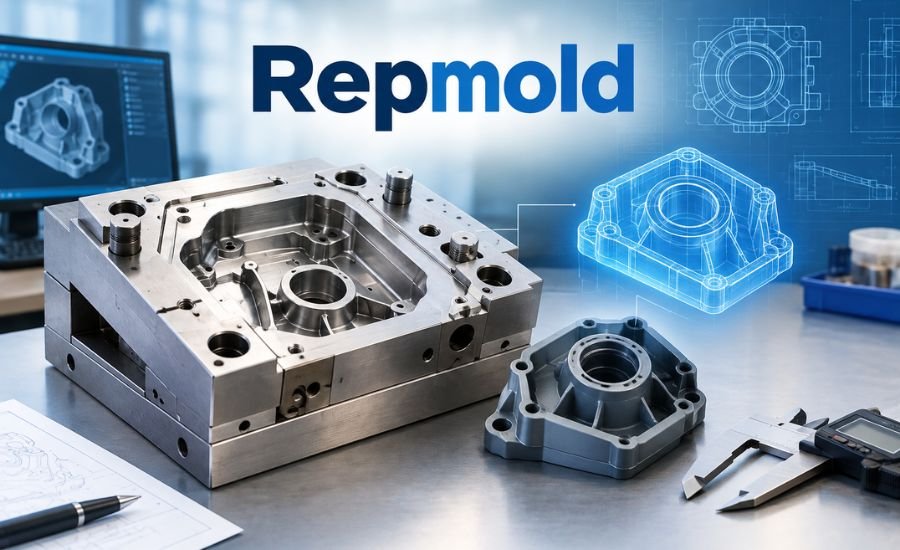
In practical terms, the concept can describe an approach in which an existing object, mold, pattern, or digital design is reproduced, refined, modified, or converted into a usable production tool. Depending on the project, this can involve CAD modeling, 3D scanning, 3D printing, CNC machining, casting, simulation, and inspection.
That makes Repmold easier to understand as a flexible concept rather than a single machine, material, or manufacturing standard. The actual workflow depends on the required accuracy, production volume, material, tooling life, budget, and application.
What Does Repmold Mean?
The word Repmold appears to combine “rep” with “mold,” although the exact expansion of “rep” has not been formally established. Online sources variously connect it with replication, reproduction, repetition, or rapid manufacturing. There is no authoritative evidence that one of these interpretations is the official definition.
The safest interpretation is that Repmold refers broadly to methods or workflows for reproducing or rebuilding molds and molded components. This interpretation fits the way the term is currently discussed alongside digital design and modern fabrication.
It is also useful to distinguish the term from remold or remould, which are established English words meaning to mold or reshape something again. Repmold should not automatically be treated as a replacement spelling for those words.
How Repmold Works
A typical Repmold-style workflow can begin with an existing component or a digital model. The first step is usually to understand the original geometry, dimensions, surface details, and functional requirements.
When the original CAD file is unavailable, 3D scanning or another measurement method may be used to capture the object’s geometry. The resulting data can then be cleaned, converted into a usable digital model, and prepared for manufacturing.
1. Capture the Original Design
The process begins by documenting the original part or mold. Engineers may use physical measurements, 3D scanning, photographs, drawings, or existing CAD files.
2. Build or Refine the Digital Model
The captured geometry is converted into a CAD environment where designers can repair surfaces, adjust dimensions, add tolerances, or modify the design for manufacturability.
3. Create a Prototype or Tool
Depending on the application, the next stage may involve 3D printing a master pattern, machining a mold with CNC equipment, or producing a prototype through another manufacturing method.
4. Test and Inspect
The first output is evaluated for dimensions, fit, surface finish, strength, and other performance requirements. Digital inspection can help identify deviations before larger quantities are produced.
5. Repeat or Scale Production
Once the design and tooling have been validated, the same setup can support repeat production. This is where the core value of replication becomes particularly important.
This workflow is consistent with modern manufacturing practices often associated with the term Repmold, although not every project will use all of these technologies.
Key Technologies Used With Repmold
A major strength of the Repmold concept is that it can connect several manufacturing technologies rather than depending on one technique.
CAD software provides the digital foundation for designing or modifying molds and components. It allows engineers to make controlled changes before physical production begins.
3D scanning is useful when manufacturers need to recreate an existing component without an original digital model. It can capture complex shapes that would be difficult to reproduce from manual measurements alone.
3D printing can produce prototypes, master patterns, fixtures, and selected molds quickly. It is especially valuable when a project requires several design iterations.
CNC machining remains important when high dimensional accuracy, strong tooling materials, or durable production molds are required.
Simulation and digital inspection can also help manufacturers identify design problems, dimensional errors, and manufacturing risks earlier in the process.
The exact technology combination should be selected according to the job rather than the name Repmold itself.
Benefits of Repmold
When used as a general approach to digital mold replication and rapid tooling, Repmold can offer several practical advantages.
Faster Development
Digital workflows can reduce the time required to move from an existing part or concept to a usable prototype or mold. Faster iterations are particularly valuable in product development.
Better Repeatability
Once a validated digital model and production process are established, manufacturers can reproduce parts with greater consistency than relying on informal manual recreation.
Easier Design Changes
Digital models can be edited before tooling is finalized. A manufacturer can adjust dimensions, surfaces, mounting points, or other details without completely restarting the design process.
Lower Prototype Risk
Rapid prototyping makes it possible to test a concept before committing to expensive production tooling. This can reduce the cost of discovering problems late in development.
Support for Legacy Parts
One promising use is reproducing older or difficult-to-source components. When original drawings are missing, scanning and reverse engineering can help create a new digital representation.
Reduced Material Waste
Better planning and digital validation can reduce some unnecessary trial-and-error work. However, the environmental impact depends on the materials, manufacturing method, energy use, and number of iterations involved.
Where Repmold Can Be Used
Potential applications for Repmold-style workflows extend across many manufacturing sectors.
Automotive
Automotive companies can use digital replication and rapid tooling for prototypes, replacement components, interior parts, housings, and design validation. Complex geometry can be captured digitally and refined before manufacturing.
Aerospace
Aerospace production places strong demands on precision and traceability. Digital inspection, reverse engineering, and controlled tooling can support prototype development and component reproduction, although aerospace applications require rigorous standards beyond simply using a replication workflow.
Medical Products
Medical device development often requires precise shapes and repeated design testing. Digital mold development can support prototypes and certain production components, provided that applicable regulatory and quality requirements are met.
Consumer Products
Household goods, electronics enclosures, accessories, packaging components, and other consumer products can benefit from faster design iterations and repeatable tooling.
Industrial Equipment
Replacement parts for machinery can be difficult to source when equipment is old or discontinued. A digital reconstruction process may help recreate a component when suitable reference data is available.
Repmold vs. Traditional Mold Making
The biggest difference is usually not a single piece of hardware but the level of digital integration.
Traditional mold making may depend heavily on manual measurement, physical patterns, machining, and repeated physical adjustments. These methods remain effective and are still widely used.
A Repmold-style workflow typically places more emphasis on capturing, editing, storing, and reusing digital information. That can make revisions easier and improve communication between designers, engineers, and production teams.
| Feature | Repmold-Style Workflow | Traditional Approach |
|---|---|---|
| Digital modeling | Often central | May be limited |
| 3D scanning | Can be included | Less common |
| Rapid prototyping | Strong fit | Varies |
| Design revisions | Easier digitally | May require more physical rework |
| Reverse engineering | Well suited | Possible but often more manual |
| Repeat production | Digital files support consistency | Depends heavily on tooling and documentation |
| The comparison is conceptual because Repmold is not a standardized manufacturing category with one fixed process. |
Common Misunderstandings About Repmold
One of the biggest mistakes is assuming that Repmold is already a universally recognized industrial technology. Current online sources do not support that conclusion. Some pages describe it as an advanced manufacturing system, while others explicitly state that the term has no single verified definition.
Another mistake is treating every digital mold-making technique as Repmold. CAD, 3D printing, CNC machining, injection molding, and reverse engineering are established technologies in their own right. They may be used together in a workflow described as Repmold, but they do not become a new standardized technology simply because the term is attached to them.
Claims about artificial intelligence should also be treated carefully. Although AI is increasingly used across manufacturing, there is not enough authoritative evidence to conclude that Repmold itself is a defined AI-powered manufacturing platform.
Is Repmold the Same as Replication Molding?
Not necessarily. Replication molding is a descriptive manufacturing concept focused on reproducing a shape or surface from an original pattern, model, or master. It can involve established molding and casting techniques.
Repmold is a less standardized term that some websites use as a broad label for mold replication, rebuilding, or digitally assisted tooling. The two ideas may overlap, but they should not be treated as exact synonyms without context.
Is Repmold Useful for Small Businesses?
The underlying techniques associated with Repmold can be useful for small manufacturers, product designers, repair businesses, and prototyping teams. Digital tools make it possible to develop prototypes and reproduce certain components without building a large traditional production setup from the beginning.
The important question is economics. A small business should compare the cost of scanning, CAD work, printing, machining, finishing, inspection, and tooling against the expected production volume. For a one-off part, direct fabrication may be more practical than creating a dedicated mold.
For repeated production, however, reusable tooling can become more attractive because development costs are spread across multiple units.
Challenges and Limitations
Despite its potential, Repmold is not a shortcut around engineering requirements. Accurate reproduction still depends on good measurement data, appropriate materials, correct tolerances, suitable tooling, and quality control.
Complex components can also require extensive post-processing. A scanned model may contain noise, missing surfaces, or dimensional inaccuracies that must be corrected before it is suitable for production.
Cost can vary widely as well. While rapid prototyping can lower some development expenses, high-performance production molds and precision machining can still require significant investment.
Finally, intellectual-property issues should not be overlooked. Reproducing an existing component does not automatically grant permission to copy a protected commercial design. Businesses should consider patents, copyrights, trademarks, contractual restrictions, and industry-specific requirements before reproducing third-party products.
How to Evaluate a Repmold Project
Before starting a Repmold-style project, define the problem rather than choosing technology based on the label.
Ask:
- Do you have the original CAD model?
- Is the original component available for scanning?
- How accurate must the final part be?
- How many units will you produce?
- What material will the final component use?
- Does the mold need to survive hundreds, thousands, or millions of cycles?
- What inspection and certification requirements apply?
These questions usually reveal whether 3D printing, CNC machining, silicone molding, casting, injection molding, or a combination of methods is the best solution.
Future of Repmold
The future potential of Repmold is closely tied to broader developments in digital manufacturing. Faster 3D scanning, improved CAD automation, additive manufacturing, better inspection systems, and increasingly connected production software are making digital workflows more accessible.
However, the future of the word itself is less certain. Since Repmold does not currently have one universally accepted technical definition, its long-term value will depend on whether manufacturers, software providers, engineers, or other industries adopt it consistently.
The underlying technologies are already well established. What remains less clear is whether the name Repmold will become a recognized industry term or remain an informal label used by different sources in different ways.
Final Takeaway
Repmold is best approached as an emerging, loosely defined term associated with mold replication, reverse engineering, rapid tooling, digital design, and modern manufacturing workflows. It can describe a useful way of connecting technologies such as CAD, 3D scanning, 3D printing, CNC machining, and inspection, but it should not be presented as a single standardized technology without supporting documentation.
For businesses and researchers, the most reliable strategy is to focus on the actual manufacturing process rather than the name. Understanding the required accuracy, material, production volume, tooling life, cost, and quality requirements will lead to better decisions than relying on the term alone.
As digital production continues to evolve, Repmold may gain a clearer definition. For now, its practical value comes from the established technologies and workflows that the term is often used to describe.