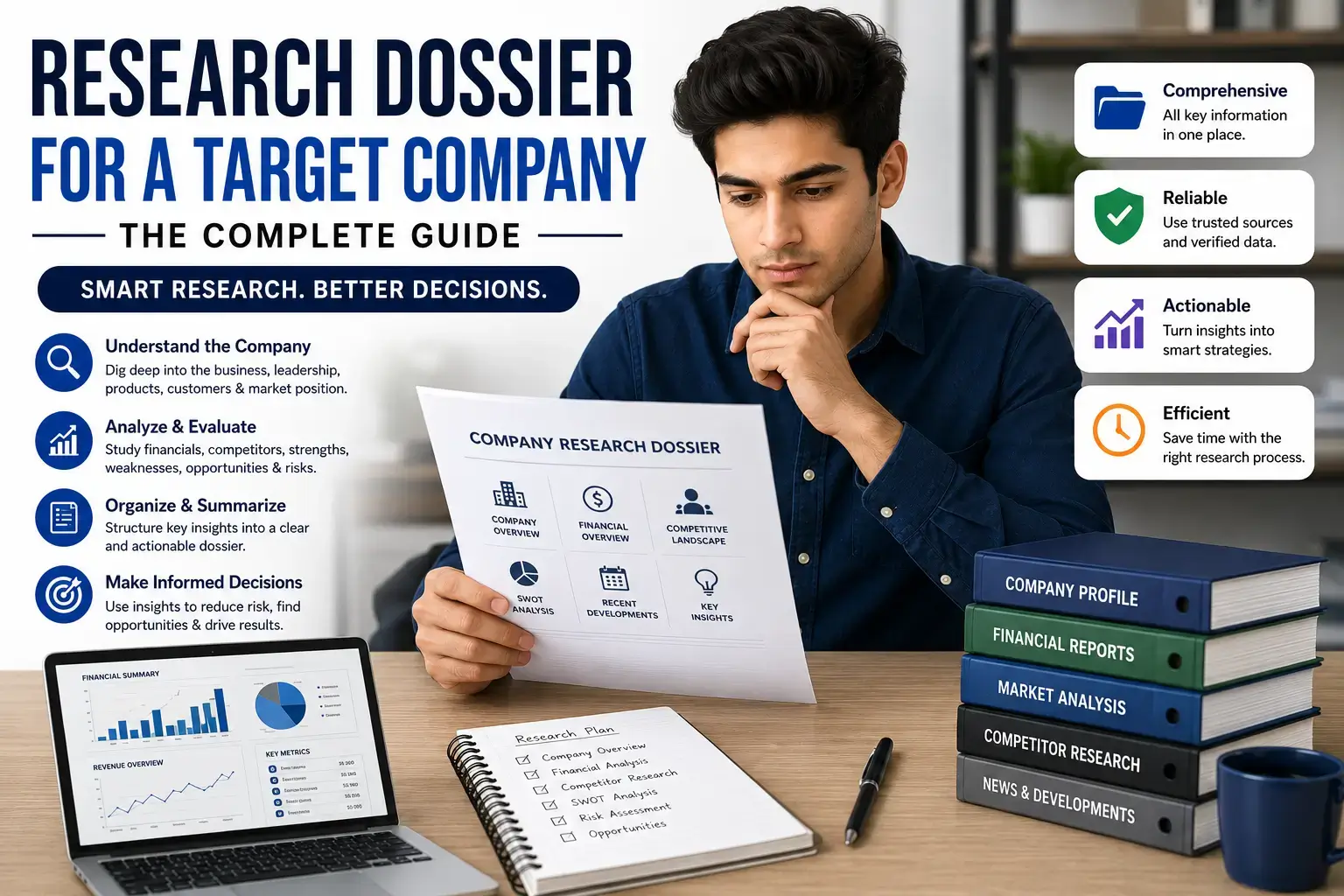
A research dossier for target company is a structured collection of information used to understand a business before making an important decision. It can support sales prospecting, investment research, partnership discussions, acquisitions, competitive analysis, supplier evaluation, or strategic planning.
Unlike a simple company profile, a research dossier connects facts, evidence, context, risks, and opportunities. The goal is not to collect everything available about a business; it is to collect the information that can change a decision.
For professionals, this distinction matters. A well-built research dossier for target company should answer practical questions such as who the company serves, how it makes money, what differentiates it, who its competitors are, what risks it faces, and whether public claims can be independently verified.
What Is a Research Dossier for Target Company?
A research dossier is a decision-oriented company investigation. It combines business facts with market intelligence and evidence from reliable sources.
A useful dossier commonly includes:
- Company overview and ownership structure
- Products, services, and target customers
- Revenue model and commercial strategy
- Leadership and key personnel
- Market position and major competitors
- Geographic footprint and expansion plans
- Recent news, announcements, and developments
- Technology, intellectual property, or operational capabilities
- Customer and partner signals
- Regulatory, legal, reputational, and financial risks
- Sources, evidence notes, and confidence levels
The strongest dossiers separate what the company says from what the evidence shows. A company website may describe a product as market-leading, for example, but independent reviews, customer references, industry data, and competitor comparisons should determine how much weight that claim deserves.
Research Dossier for Target Company: Search Intent
The keyword research dossier for target company carries primarily informational and guide-focused intent. A person searching it is likely looking for a practical framework for investigating a specific business rather than a generic definition alone.
That means an effective approach should provide a repeatable research process. Readers need to know what to investigate, where to look, how to evaluate conflicting information, and how to convert findings into a useful business conclusion.
This also makes the topic relevant to analysts, sales teams, entrepreneurs, investors, consultants, researchers, journalists, and business development professionals.
Why a research dossier for target company Matters
Business decisions often fail because information is fragmented. One source explains the company’s products, another reveals a leadership change, a third shows a competitor winning customers, and a fourth exposes a regulatory issue.
A research dossier for target company brings those fragments into one decision-ready record. It helps reduce three common problems: incomplete research, excessive reliance on company claims, and failure to connect individual facts into a larger business picture.
A dossier can also make research faster over time. Once a standard structure exists, new companies can be evaluated using the same categories, creating more consistent comparisons.
Core Sections of a Research Dossier for Target Company
1. Company Identity and Background
Start with the fundamentals. Record the legal or trading name, headquarters, founding year, ownership type, major locations, websites, subsidiaries, brands, and business category.
Then build a short timeline of major events. Look for founding, product launches, acquisitions, funding events, leadership transitions, major partnerships, market entries, restructurings, and exits.
The timeline is especially valuable because a company may appear stable when viewed only through its current website. Historical events can reveal a very different strategy.
2. Products, Services, and Business Model
Document exactly what the company sells and who pays for it. Avoid vague descriptions such as “technology solutions” or “business services.”
Break offerings into specific products or service lines. Identify pricing models where publicly available, contract structures, recurring versus one-time revenue, customer segments, distribution channels, and potential switching costs.
A particularly useful question is: What has to be true for this business model to work? The answer may reveal dependencies on enterprise contracts, advertising, suppliers, regulations, data access, or a particular customer segment.
3. Leadership and Organization
Leadership research should go beyond listing executives. Investigate professional backgrounds, previous companies, relevant expertise, tenure, major appointments, board relationships, and notable public statements.
Look for patterns. Frequent executive turnover may indicate organizational pressure, while a leadership team with deep industry experience may support credibility. Neither conclusion should be made from one data point; look for corroborating evidence.
4. Market and Industry Position
A company cannot be evaluated in isolation. Add industry size, growth patterns, customer demand, major trends, technological changes, and regulatory developments relevant to the business.
Then identify the company’s apparent market position. Is it a niche specialist, emerging challenger, established incumbent, low-cost provider, premium brand, or platform business?
This section becomes much stronger when you explain why the company occupies that position rather than simply labeling it.
5. Competitor Analysis
Competitors should be selected based on customer alternatives, not just similar keywords or industries.
Create a comparison covering products, target audience, geographic reach, pricing approach, differentiation, distribution, technology, partnerships, and notable strengths or weaknesses.
A simple comparison framework can look like this:
| Factor | Target Company | Competitor A | Competitor B |
|---|---|---|---|
| Core offering | Primary product/service | Alternative offering | Alternative offering |
| Main customers | Key segment | Key segment | Key segment |
| Differentiator | Main advantage | Main advantage | Main advantage |
| Geographic focus | Primary markets | Primary markets | Primary markets |
| Major risk | Known exposure | Known exposure | Known exposure |
| The purpose is not to declare a winner. It is to identify where the target company has a defensible advantage and where it may be vulnerable. |
How to Collect Reliable Evidence
A research dossier for target company is only as credible as its sources. Prioritize primary sources when establishing facts, then use independent sources to test important claims.
Primary sources may include regulatory filings, official company announcements, investor materials, government records, patents, court documents, and official executive statements.
Secondary sources can provide context through reputable business publications, industry reports, specialist trade media, academic research, analyst commentary, and credible interviews.
For every important claim, record the source and publication date. If multiple sources disagree, do not quietly choose the version that fits your narrative. Flag the conflict and investigate why the difference exists.
Build an Evidence and Confidence System
One of the most useful improvements to a traditional research dossier for target company is a confidence system.
Classify findings as:
- Verified: Supported by strong primary or authoritative evidence
- Corroborated: Supported independently by multiple credible sources
- Reported: Published by a credible source but not independently confirmed
- Claimed: Stated by the company or another interested party
- Unclear: Evidence is conflicting, outdated, or insufficient
This prevents weak information from looking as authoritative as verified facts.
You can also maintain an evidence ledger with four columns: claim, source, date, confidence. This small habit dramatically improves the quality of later analysis.
Investigate Financial and Commercial Signals
Financial information should be assessed according to the company’s ownership structure. Public companies may provide detailed filings, while private businesses often require a more indirect approach.
Look for available indicators such as funding rounds, reported revenue, employee growth, major customers, contract announcements, pricing changes, acquisitions, hiring patterns, and geographic expansion.
Do not treat funding as proof of business health. Likewise, a growing headcount does not automatically mean growing profits. Each signal needs context.
For private companies, triangulation is especially important. Several moderate signals may collectively be more informative than one impressive announcement.
Examine Reputation, Legal, and Regulatory Risk
Risk research is often the section that turns a basic profile into a professional dossier.
Search for lawsuits, regulatory actions, recalls, sanctions, compliance issues, major customer disputes, data incidents, intellectual-property conflicts, executive controversies, and significant negative reporting.
The objective is not to produce a negative profile. It is to determine whether a risk is isolated, historical, recurring, resolved, or still developing.
Pay particular attention to the difference between an allegation and a confirmed finding. A responsible research dossier for target company should make that distinction explicit.
Look for Customer and Market Signals
Customer evidence can reveal gaps between positioning and reality. Examine independent reviews, case studies, testimonials, customer announcements, user discussions, job postings, implementation stories, and recurring complaints.
The key is pattern recognition. One negative review tells you very little. A repeated complaint across unrelated sources may identify an operational weakness worth investigating.
Positive evidence should be treated the same way. A company may publish several case studies, but independent customer references can provide a more balanced view of actual performance.
Common Mistakes to Avoid
The biggest mistake is confusing information volume with research quality. A 50-page dossier filled with uncited facts can be less useful than a 10-page report built around verified evidence.
Another common error is researching only the target company’s preferred narrative. Company websites are valuable starting points, but they are designed to communicate strategically.
Avoid relying on outdated information, copying competitor lists without testing relevance, and treating search-engine snippets as evidence. Also avoid presenting assumptions as facts simply because they sound reasonable.
Finally, do not bury the conclusion beneath research. Senior decision-makers usually need the implications quickly.
Turn Research Into Strategic Findings
A high-quality research dossier for target company should end with interpretation, not just information.
Convert observations into implications:
- A new partnership may indicate a shift in distribution strategy.
- Rapid hiring in one function may signal expansion or capability building.
- Increasing regulatory attention may raise future compliance costs.
- Repeated customer complaints may point to an operational constraint.
- A concentrated customer base may create revenue risk.
This is where research becomes intelligence. The value is not simply knowing that something happened; it is understanding why it matters.
A Practical Research Workflow
Start by defining the decision the dossier will support. The questions for a potential acquisition will be different from those used for sales prospecting.
Next, gather baseline facts and build the company timeline. Then research the business model, leadership, market, competitors, customers, financial signals, and risks.
After collecting information, verify the most important claims independently. Assign confidence levels and identify gaps that could materially affect the conclusion.
Finally, write an executive summary containing the company’s position, major strengths, principal risks, competitive advantages, unresolved questions, and recommended next steps.
This approach keeps a research dossier for target company focused on decisions rather than turning into an unstructured archive of links.
A Simple Quality Checklist
Before finalizing your dossier, confirm that it answers these questions:
- What does the company actually sell?
- Who are its most important customers?
- How does it make money?
- What differentiates it from realistic alternatives?
- Who are its strongest competitors?
- What evidence supports the company’s major claims?
- What are the most significant commercial, legal, operational, or reputational risks?
- Which facts are verified, and which remain uncertain?
- What recent developments could change the assessment?
- What should the decision-maker do with this information?
If several answers are missing, the dossier is probably not finished.
How to Make research dossier for target company More Useful
The best research dossier for target company is concise enough to use and detailed enough to trust. Put critical findings near the beginning, use tables where comparisons matter, and link each significant claim to supporting evidence.
Separate raw facts from analysis. For example, “the company opened three offices in 2026” is a factual observation, while “this suggests an aggressive regional expansion strategy” is an interpretation. Keeping those statements distinct makes the report easier to challenge and update.
Add a “What We Still Don’t Know” section when appropriate. Identifying information gaps is not a weakness; it demonstrates research discipline.
Final Thoughts
A research dossier for target company should function as a decision tool, not a collection of copied information. The strongest dossiers combine structured company research, competitive intelligence, source verification, risk analysis, and clear strategic interpretation.
The process is straightforward: define the decision, gather authoritative evidence, test company claims, compare realistic alternatives, identify risks, rate confidence, and turn the findings into implications.
When done consistently, a research dossier for target company gives sales teams, investors, analysts, consultants, and business leaders a clearer view of what is known, what is uncertain, and what deserves attention next.
Ultimately, the value of a research dossier for target company is measured not by how many facts it contains, but by whether those facts help someone make a better-informed decision.